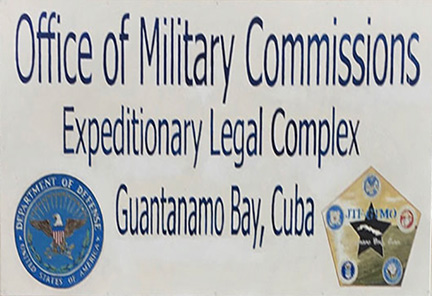
Legal proceedings in the case against the five men accused of planning and supporting the 9/11 attacks are stalled as multiple issues wend their way through four different military and federal courts. The current (and fifth) presiding judge in the case, Lt. Col. Michael Schrama, has taken an novel approach, cancelling all June and July hearings while he focusses on issuing decisions on the scores of fully briefed but undecided motions that have been filed since 2012, when pre-trial hearings began. Chief among them, a prosecution motion to find three of the defendants’ confessions to the FBI voluntary. The issue of suppressing or allowing the statements to be presented at trial has loomed over the 9/11 case from the beginning, as defense attorneys have litigated multiple demands for witnesses and access to classified documents. Both sides agree it is key to setting a trial date.
But the path to a final decision on the admissibility of the 2007-08 “confessions” to FBI interrogators who came to Guantánamo as “clean teams” (totally different from CIA interrogators, the government maintains) is far from straightforward.
One defendant, Ammar al-Baluchi, already successfully convinced the previous 9/11 judge that his FBI testimony could not be used at trial. The prosecutors in the 9/11 case have appealed this ruling in the Court of Military Commissions Review (CMCR). The three judges who heard arguments on the issue are expected to render their decision sometime this summer. Whatever the CMCR judges decide, the decision will likely be appealed to the DC Circuit Court of Appeals, and possibly to the Supreme Court.
While it does not establish a legal precedent in the 9/11 military commission, it is significant that in 2023, the judge in the case of U.S. v. Abd al Rahim al Nashiri, the man accused of plotting the bombing of the U.S.S. Cole, ruled his FBI confession was inadmissible. In 2025, the CMCR upheld the ruling, affirming that his “confession” was legally “tainted” and rendered “involuntary” by the brutal torture Mr. al Nashiri endured at CIA “black sites” prior to the FBI interrogation.
The current 9/11 judge says he intends to issue a ruling on the confessions of three of the 9/11 defendants – Khalid Sheik Mohammed (the 9/11 “mastermind), Walid bin Attash, and Mustafa al-Hawsawi – by August. He will need to rule on each defendant separately, as they each had different experiences of CIA torture and of their later transition to Guantánamo. Mr. al-Hawsawi, for example, was for a period of time detained at Guantánamo when the CIA was still using it as a “black site.” His attorney argued forcefully that there was no way his client could ever experience any interrogation at Guantánamo as anything other than a continuation of CIA interrogation, that could lead at any time to renewed torture; in other words, he was programmed to tell the FBI agents “what they wanted to hear.”
Attorneys for all three defendants argued that their clients were not given a Miranda warning, notifying them of their right to remain silent, their right to have an attorney present, and the fact that anything they said could be used against them in court of law. Mr. Mohammed, in fact, asked if he could have an attorney and was falsely told that he was not yet charged with any crime, despite that fact that the FBI agents were brought to Guantánamo explicitly to obtain confessions to be presented at trial.
Further muddying the water, two years ago, in a surprising revelation in the 9/11 pre-trial hearings, veteran FBI analyst Kimberly Waltz testified that during the Obama Administration, when moving the 9/11 trial to Federal District Court in New York was being contemplated, the Justice Department decided it would not try to use the FBI “confessions” evidence in court. This was later confirmed by former federal prosecutor Adam S. Hickey.
There is no current litigation concerning the FBI interrogations of the fifth 9/11 defendant, Ramzi bin al-Shibh, because his case was severed following a ruling by the previous 9/11 judge that he was mentally incapable of participating in his own defense as a result of PTSD and a delusional disorder that developed following his torture in the CIA “black sites.”
Should the current 9/11 judge find any of the defendants’ statements to the FBI admissible, Khalid Sheik Mohammed, Walid bin Attash, and Mustafa al-Hawsawi’s defense attorney’s will be allowed to call witnesses and present additional arguments in the 9/11 pre-hearings. They are currently blocked from filing new motions in the military commissions until there is a final decision about the legality of the pre-trial agreements they signed in 2024, which were subsequently retracted by then Secretary of Defense, Lloyd Austin.
The one certainty about the prospects for a trial of the 9/11 accused, is that it will not start on January 11, 2027, as the prosecuting attorneys have requested.