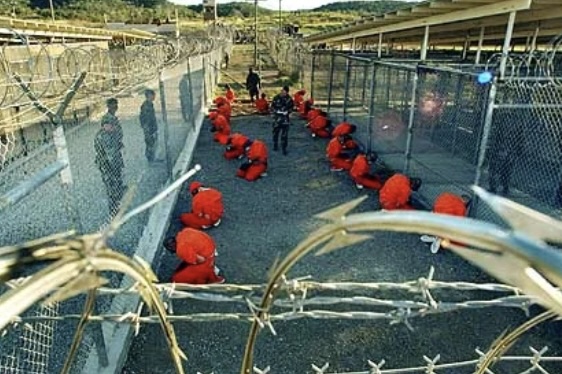
The day before Camp X-Ray was revealed to the American public in 2002, the Bush Administration prison commander at Guantánamo claimed the inmates would be “the worst of the worst.” On January 19, 2026, the DHS (Department of Homeland Security) assured the American public, “ICE Continues to Remove the Worst of the Worst from Minneapolis Streets.”
On the 24th anniversary of the opening of Guantánamo, September 11th Families for Peaceful Tomorrows (a founding member of UFPJ) issued a statement on Guantánamo’s legacy: “On January 11, 2002, the first ’War on Terror’ detainees arrived at Camp X-Ray. Unnamed and unknown, these twenty men in orange jumpsuits ushered in an era of extraordinary rendition, terror jingoism, and a lack of accountability that continues to this day.”
Their statement continues, “When men in blindfolds arrived at the Guantánamo Naval base, they found themselves in a jurisdictional no man’s land. 24 years later, the world remains blind to the situation of the 15 men who remain at Guantánamo, and the history of how we got here. Furthermore, the five men alleged to have planned and supported the 9/11 attacks have yet to be held legally accountable. Indeed, the Guantánamo Military Commission has not even set a trial date. . . . America has institutionalized a politics of fear. Just as our nation was scared into compliance in the aftermath of 9/11, we are being frightened into numbness now.”
Since February 2025, over 700 immigrants – most of them transported from the United States – have been temporarily detained at Guantánamo’s Migrant Operations Center or at Camp 6, part of the military detention facility. Read Peaceful Tomorrows’ full statement HERE.
An outpouring of anger, frustration, and sadness has marked this year’s shameful anniversary. A statement from 115 U.S.-based organizations committed to human rights and the rule of law (including UFPJ, and our member organization, September 11th Families for Peaceful Tomorrows, FCNL, CPDCS, and PANYS) calls for:
1) Transferring without delay the six men who are not charged with a crime.
2) Ending the failed military commissions and resolving pending cases.
3) Permanently closing the Guantánamo military detention facility, without repurposing it for any future detention regime.
4) Holding perpetrators of U.S. crimes accountable; and
5) Providing redress to those whose fundamental human rights the U.S. has violated.
The 24th anniversary of Guantánamo’s opening also saw worldwide protests.
Only fifteen “war on terror” prisoners remain of the approximately 780 Muslim men and boys the Bush Administration sent to the Guantánamo military detention facility after 9/11. That is because over 97% of the detainees were never charged. Instead, they were “rendered” yet again to various countries around the world without their input or consent.
Life after Guantánamo is filled with challenges, as these former detainees make clear. Mansoor Adayfi organized and supports the Guantanamo Survivors Fund, which recognizes how, after suffering years of torture and imprisonment without charge, former detainees have been transferred to countries far from their families, where they are stigmatized, receive little or no assistance, and have no legal status or permit to work. The Guantanamo Survivors Funds supports men working to rebuild their lives. Read Mansoor Adayfi’s book, Don’t Forget Us Here, where he shares with great insight and empathy a narrative of fighting for hope and survival in unimaginable circumstances.
Another former detainee, Mohamedou Ould Slahi, discussed his current situation with Nael Georges, Middle East and North Africa Programme Coordinator at PEN International. Slahi ends with a powerful message to U.S. citizens: “Readers should know that law and democracy are valid and useful, and that despising democracy and human rights is invalid and inadmissible. Why am I saying that? Because the US said it would be torturing me until I confessed, then it would take me to court and prosecute me. I was sent to be tortured in Jordan, Afghanistan and Guantanamo, and yet it [the US] was unable to bring me before the court. The US did all that so it could collect proof of violence and sentence me in court. The United States failed. Why? Because a state of law is the only one that is valid.”
Is the United States TODAY a state of law? If we reflect on the 24 years of the Guantánamo Detention Facility and the former detainees’ messages, we must conclude otherwise.