
By John Burroughs, Senior Analyst, Lawyers Committee on Nuclear Policy, and Board Member, Western States Legal Foundation
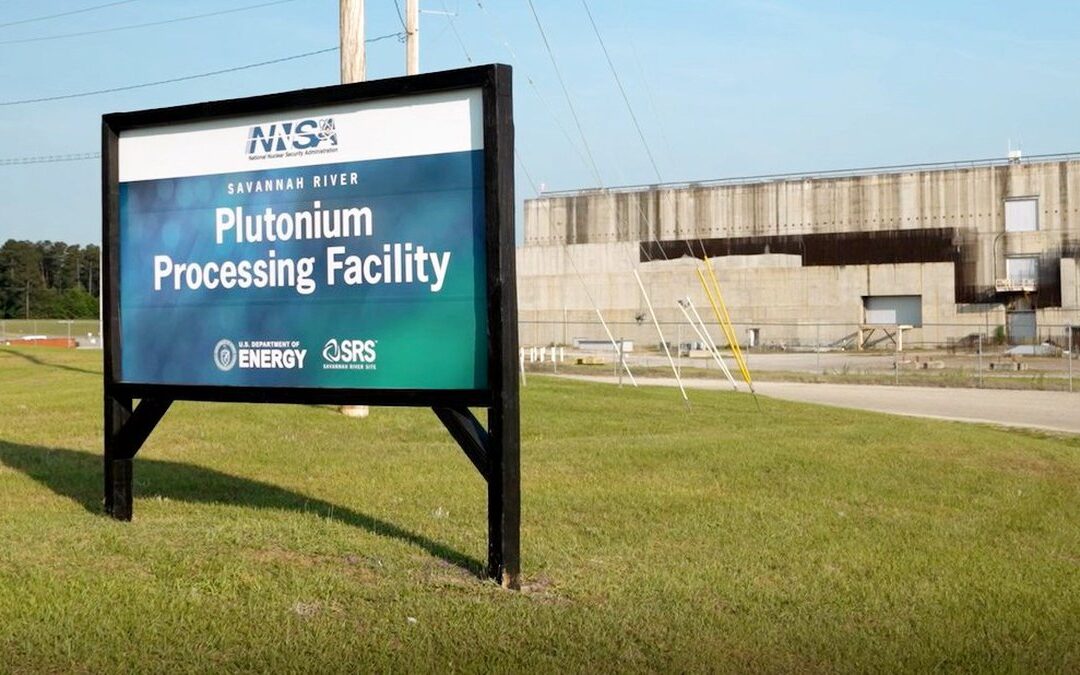
The United States is now planning to establish an infrastructure capable of producing at least 80 plutonium pits for nuclear weapons per year. The project is well described and criticized in a comprehensive report released in May by the Union of Concerned Scientists. In the current approach, facilities would be located at Los Alamos National Laboratory, in New Mexico, and the Savannah River Site, in South Carolina. In a settlement of a lawsuit brought by activist groups (see video), the National Nuclear Security Administration (NNSA) agreed to conduct programmatic environment review of this major project. This summer the NNSA accepted public comments on the scope of the review.
Many NGOs submitted comments, including the groups that brought the lawsuit resulting in the review: Savannah River Site Watch of Columbia, SC; Nuclear Watch New Mexico of Santa Fe, NM; Tri-Valley Communities Against a Radioactive Environment (CAREs), based in Livermore, CA; and the Gullah/Geechee Sea Island Coalition of coastal Georgia. Other submissions included one from Lawyers Committee on Nuclear Policy and Western States Legal Foundation. Their comment focused on the nuclear disarmament obligation under Article VI of the Nuclear Non-Proliferation Treaty and argued that the NNSA must consider a true no-action alternative of no pit production.
According to the comment: “If the United States and other nuclear-armed states, in particular China and Russia, in accordance with Article VI take a negotiated path to the global elimination of nuclear weapons in the foreseeable future, there will be no need, perceived or real, for plutonium pit production. While the current international landscape is not conducive to that enterprise, it should not be assumed that pit production will take place over the next several decades. The negotiation of the abolition of nuclear arms is a legal obligation of extraordinary practical and moral importance. The [Programmatic Environmental Impact Statement (PEIS)] should not assume non-compliance with the obligation.”
The comment also observed: “Additionally, a sometimes overlooked element of Article VI is cessation of the nuclear arms race at an early date. Production of pits for new-design warheads on a new delivery system, the Sentinel ICBM, and on submarine-based ballistic missiles, has aspects of nuclear arms racing, both in reality and, importantly, as it is perceived by rival nuclear-armed states. If the W87-1 serves to enable MIRVing [placement of multiple warheads] of the Sentinel ICBM, it would contribute to quantitative arms racing; MIRVing also would be destabilizing. Moreover, according to the Department of Defense, the Sentinel ICBM will have enhanced capabilities and thus its development and deployment amounts to qualitative arms racing. It also appears that the W93 warhead for submarine-based missiles will add some military capability ….”
It concluded: “The PEIS should not rule out the possibility that nuclear arms racing will cease and nuclear disarmament will be implemented in accordance with NPT Article VI …. Failing to consider a true no-action alternative would have that effect.”