By Jackie Cabasso, Executive Director, Western States Legal Foundation
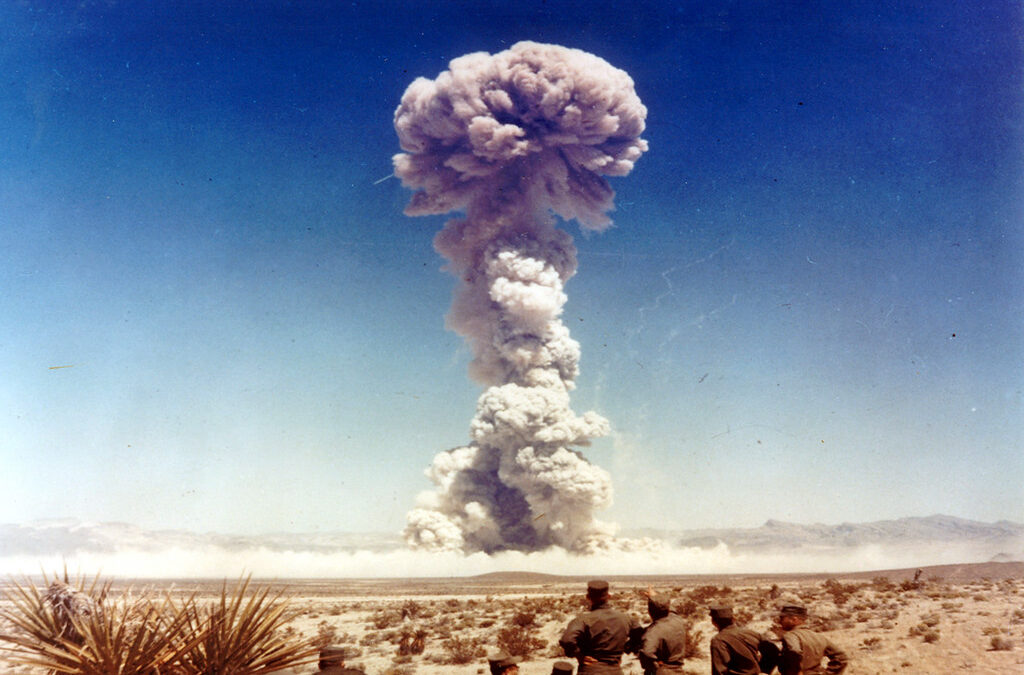
Photo: U.S. government
As the UN Secretary General warned on the September 26 International Day for the Total Elimination of Nuclear Weapons, “nuclear testing threats are returning, while nuclear saber rattling is louder than in past decades.” Indeed, threatening to return to full scale explosive nuclear testing is a potent form of nuclear saber rattling.
With chaos and uncertainty arising from Donald Trump’s October 29 factually challenged social media post, “Because of other countries testing programs, I have instructed the Department of War to start testing our Nuclear Weapons on an equal basis. That process will begin immediately,” the U.S. government’s first ever No vote, two days later, on the annual General Assembly resolution in support of the Comprehensive Test Ban Treaty (CTBT) raises further troubling questions about U.S. intentions.
Trump did not specify whether he meant full-scale explosive nuclear testing, missile tests, or something else. Russia and China are not conducting explosive nuclear tests, so the U.S. has no basis to respond in kind. They are conducting missile tests, but so is the United States. In fact, the U.S. conducted a “routine” test of an unarmed Intercontinental Ballistic Missile on November 5. The Department of Defense (Department of War) is responsible for missile tests, but it is the Department of Energy that is responsible for preparation for explosive nuclear testing.
On November 2, Energy Secretary Chris Wright sought to explain Trump’s post when he told Fox News “I think the tests we’re talking about right now are system tests. These are not nuclear explosions. These are what we call non-critical explosions.”
The waters were further muddied by Trump’s unsubstantiated allegations in an interview with 60 Minutes (recorded October 31 but aired November 2) that Russia and China have been secretly conducting explosive nuclear tests deep underground.
Since 1945, there have been 2,056 nuclear weapons tests by at least eight countries. Most of these tests have been conducted on the lands of indigenous and colonized people. The United States conducted 1,030 of those tests in the atmosphere, underwater, and underground, while the USSR carried out 715 nuclear test detonations. Not only did these nuclear test explosions fuel the development and spread of nuclear weapons, but hundreds of thousands of people have died and millions more have suffered—and continue to suffer—from illnesses directly related to the radioactive fallout from nuclear detonations in the United States, islands in the Pacific, in Australia, China, Algeria, across Russia, in Kazakhstan, India, Pakistan, North Korea, and elsewhere.
While a nearly universal moratorium on nuclear testing has held since 1992, followed by negotiation of the Comprehensive Test Ban Treaty (CTBT) in 1996, the treaty has not yet entered-into-force due to the recalcitrance of seven nuclear armed states which have not signed or ratified the treaty. The United States, China, Israel, and the Russian Federation have signed but not ratified the CTBT. North Korea, India, and Pakistan have neither signed nor ratified it.
In recent years, as a new nuclear arms race has gotten underway, there are signs that some of these countries may be considering resuming nuclear testing. In 2020, the DPRK announced it “will no longer observe its self-imposed moratorium on nuclear testing.” To date, it has not yet resumed nuclear testing but has announced plans to increase the size and diversity of its nuclear arsenal. In 2023, the Russian Federation withdrew its ratification of the CTBT to maintain parity with the United States.
The new head of the U.S. National Nuclear Security Administration, Brandon Williams, during his confirmation hearings said he would advise against resuming explosive nuclear tests. However, Project 2025, proposes that a second Trump administration prioritize nuclear weapons programs over other security programs, accelerate the development and production of all nuclear weapons programs, increase funding for the development and production of new and modernized nuclear warheads, and prepare to test new nuclear weapons. Separately, Robert O’Brien, Trump’s national security advisor during his first term, wrote in Foreign Affairs, that in order to counter China and Russia’s continued investments in their nuclear arsenals, the U.S. should resume nuclear testing. And keep in mind that Russell Vought, one of the architects and co-authors of Project 2025, is now the Director of the powerful Office of Management and Budget.
If the U.S. were to resume explosive underground nuclear testing, it is almost certain that Russia would reciprocate, followed by North Korea, and possibly China and India, setting off a new 21st century multilateral nuclear arms race.
Trump’s nuclear testing “announcement” would seem to contradict his apparently off-the-cuff remark to the 80th session of the United Nations General Assembly, that “We want to have a cessation of the development of nuclear weapons.” Trump’s FY26 funding request for the Department of Energy, including its National Nuclear Security Administration, at $34 Billion, sustains or provides increased funding for six new nuclear bombs and warheads.
As we continue to advocate for nuclear risk reduction and the global elimination of nuclear weapons, we must remain vigilant that the option of nuclear weapons testing remains off the table.
Read US Stands Alone Defying UN Vote on Nuclear Test Ban Treaty. Watch Fallout from decades of nuclear testing in Southern Nevada (6 minutes). See also Trump’s Nuclear Testing Threat: Playing with More Than Dynamite.