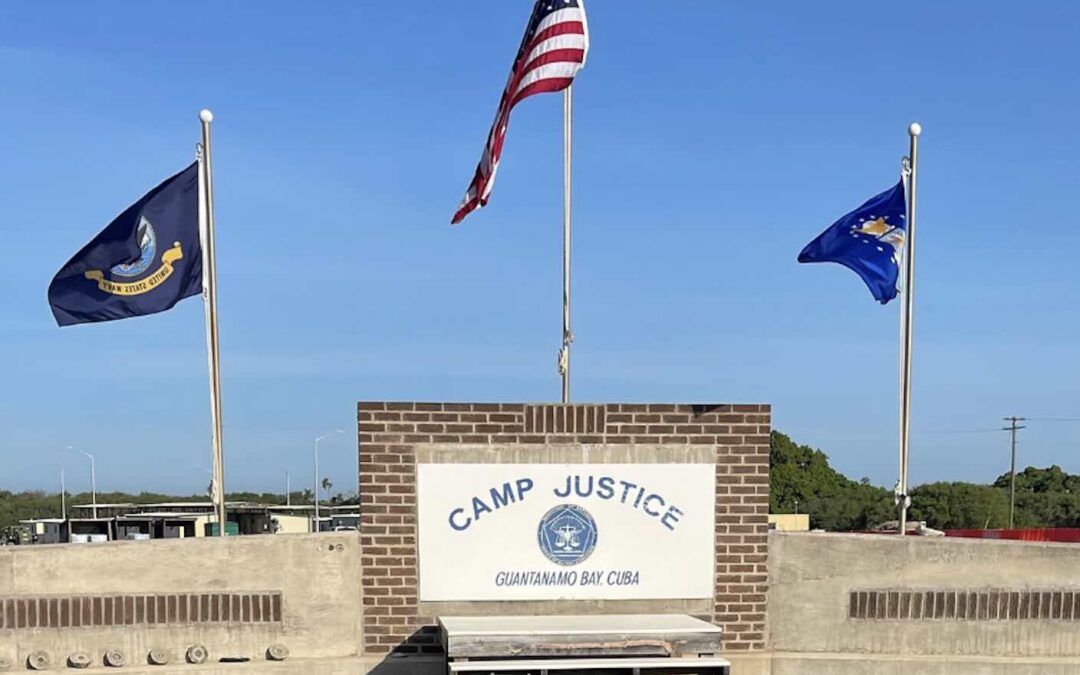
On June 1, Air Force Colonel Matthew McCall, the fourth judge to preside over the 9/11 Military Commission pre-trial hearings at Guantanamo retired, as he had long ago announced he would. His final significant ruling in the hearings, which in May entered their 13th year, dealt a severe blow to the prosecution.
McCall suppressed the confessions of defendant Ammar al Baluchi because of his torture by the CIA, despite that fact that his confessions were made later to an FBI “clean team.” The suppression issue has been central to the 9/11 legal proceedings from their beginning, because all the 9/11 defendants, indeed all the Muslim men charged in the Guantanamo military commissions were tortured in CIA “black sites.”
No legal effort has ever been made by the U.S. government to pursue accountability for the gross violations of human rights and humane treatment—rights explicitly guaranteed under the International Covenant on Civil and Political Rights and the Convention Against Torture, both of which the U.S. signed.
Following President Obama’s decision to “look forward not backward,” and his refusal to investigate let alone prosecute those who ordered and carried out torture, it seemed there would be no reckoning. Yet in an odd twist, the legal arguments, motions, and rulings over suppression in the 9/11 case (and the USS Cole Bombing case, another of the Guantanamo cases in pre-trial hearings) have become the only legal venue in which the details of post-9/11 torture and what it cost our nation’s prospects for truth, justice, and accountability are publicly argued.
Judge McCall’s ruling suppressing confessions to the FBI applies to only one 9/11 defendant, Ammar al Baluchi, as three other defendants had signed pre-trial agreements (PTAs) last year, pleading guilty to all charges against them in exchange for a promise they will not facing a death penalty conviction. As a result, they and their lawyers have been observing, but no longer participating in the legal proceedings at Guantanamo.
The three who signed PTAs include the alleged “9/11 Mastermind,” Khalid Sheikh Mohammed (known as KSM), Walid bin Attash, and Mustafa al-Hawsawi. A decision on the legality of their PTAs has been long awaited from the DC Circuit Court, which heard oral arguments on the issue in January of this year.
The fifth defendant in the 9/11 case, Ramzi bin al-Shibh, was declared mentally incompetent to participate in his own defense, as a result of the long-lasting effects of his torture. His case has been severed from that of the other four defendants. While the prosecution maintains that Mr. bin al-Shibh can be restored to mental competency and will again be able to stand trial, his defense team sees no potential for that.
So, what now are the prospects for justice and accountability for the crimes of 9/11?
UFPJ founding member organization September 11th Families for Peaceful Tomorrows has long advocated for PTAs. The organization filed an amicus brief with the DC Circuit Court that was joined by 9/11 victim family members who are not members of Peaceful Tomorrows, stating clearly its long-held convictions that PTAs are the only path to judicial finality. Whichever way the DC Circuit Court rules on the legality of the existing PTAs, the decision will almost certainly be appealed to the Supreme Court.
Meanwhile, the prosecution in the 9/11 case is appealing Judge McCall’s suppression ruling through the military commission appeals process. That issue too could end up in the DC Circuit Court and go on to the Supreme Court.
But, back at Guantanamo there does not appear to be a qualified military judge who is willing to take over the 9/11 case. So, for the foreseeable future, 9/11 pre-trial hearings are cancelled one week at a time as an “administrative judge” handles day-to-day legal minutia. With the 24th anniversary of the 9/11 attacks rapidly approaching, victim family members and the American nation just wait and wonder if there will ever be judicial finality. Or will the alleged perpetrators of the 9/11 attacks simply die “legally innocent”?